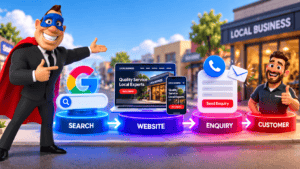
Building a business website with WordPress is easier than it used to be. Building one that actually helps your business is a different story.
You can have WordPress installed in minutes, choose a nice-looking theme and publish a few pages. But that does not automatically give you a website that gets found, builds trust or turns visitors into enquiries.
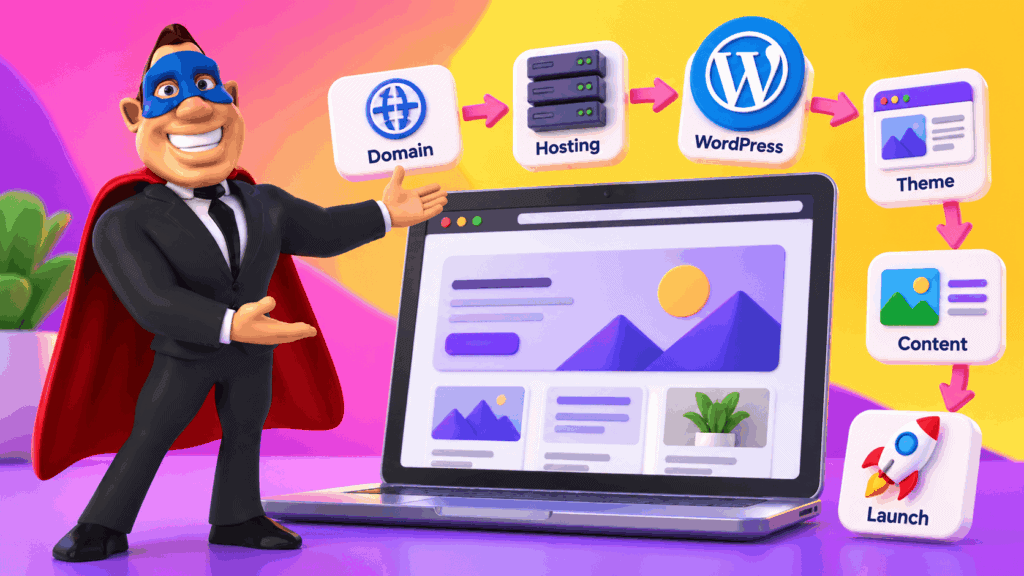
That is why it helps to understand how the main pieces fit together.
You do not need to become a web developer. You just need enough knowledge to make good decisions, avoid common mistakes and understand what your website needs to do for your business.
This guide walks you through the full process in plain English and explains why each step matters, not just what button to click.
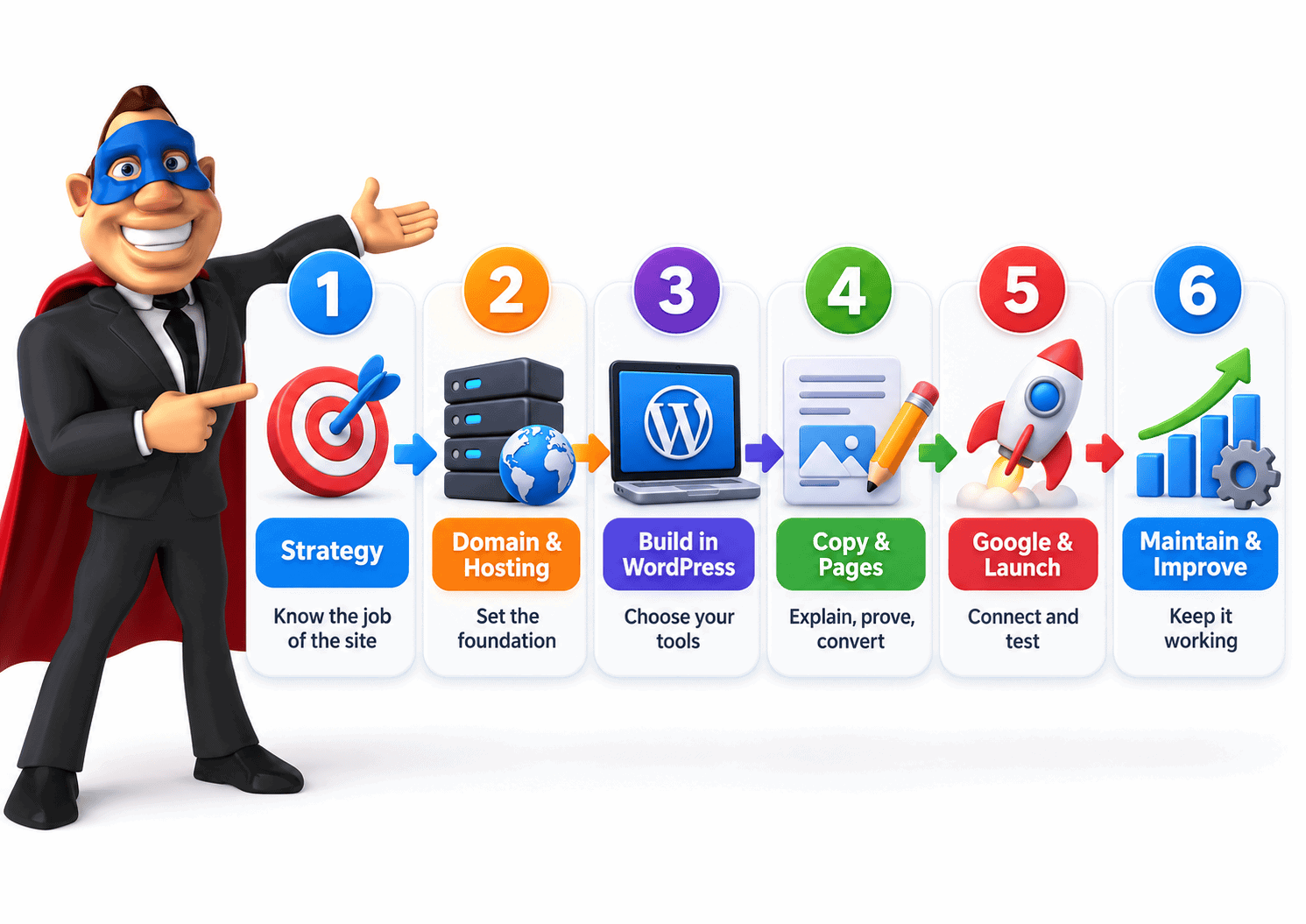
1. Start with the job of the website
Before you buy hosting, pick colours or choose a theme, decide what the website is supposed to achieve.
For most local businesses, the job is not “have a website”. The job is to help the right person move from:
“I need help” → “This business looks right for me” → “I’m going to contact them.”
That means your website should help people:
- find you
- understand what you do
- see why it matters to them
- trust you
- take the next step
Why this matters: If you do not know the job of the website, it is very easy to spend time and money building something that looks impressive but does not help produce enquiries.
At Bizi Media, we call this a Local Lead Website. The website is built around the customer journey, not around showing off the technology.
2. Know who the website is for
A website becomes much easier to write when you know exactly who you are talking to.
Think about:
- who your ideal customers are
- what problem they are trying to solve
- what frustrates them about businesses like yours
- what they are worried about
- what result they really want
This is where benefit-led copy starts.
Most businesses naturally talk about themselves:
“We have 20 years of experience.”
“We use premium equipment.”
“We offer fast turnaround.”
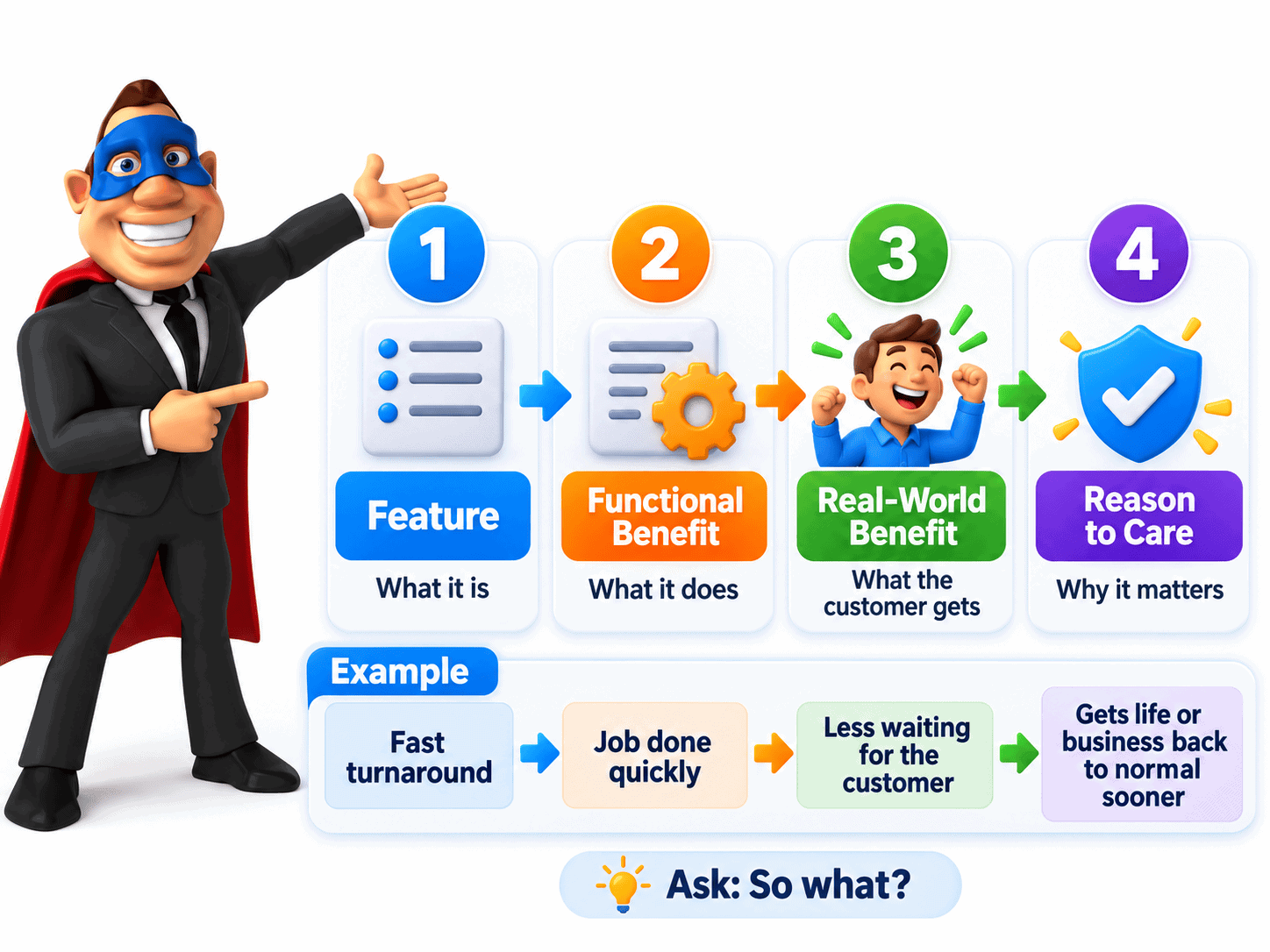
Those things can be useful, but the customer is still asking: So what does that mean for me?
Turn features into benefits:
20 years of experience → fewer surprises and more confidence the job will be done properly.
Premium equipment → a better result, less risk and potentially less downtime.
Fast turnaround → less waiting and faster return to normal.
Why this matters: People rarely buy the feature itself. They buy the result, convenience, confidence, time saved, money saved or risk reduced.
A useful test is to keep asking “So what?” until you reach the real customer benefit.
3. Choose your domain name
Your domain name is the address people type into their browser, such as yourbusiness.com.au.
For an Australian local business, a .com.au domain is often a strong choice because it immediately feels local and familiar.
Choose a domain that is:
- easy to remember
- easy to spell
- easy to say out loud
- close to your business name
- free from unnecessary hyphens or confusing wording
Do not force keywords into the domain if it makes the name awkward.
Why this matters: A confusing domain creates friction. Every extra explanation is another opportunity for someone to mistype it, forget it or question whether they have found the right business.
Most importantly, register the domain in your own name or business name and keep access to the account.
Bizi tip: Your domain is an important business asset. Even if somebody else sets it up for you, you should know where it is registered and how to access it.
4. Choose reliable WordPress hosting
Hosting is where your website files and database live.
You do not need the most expensive hosting available, but you do want something dependable.
Look for:
- support for current WordPress and PHP versions
- SSL included
- regular backups
- good support
- reasonable server performance
- simple WordPress management
- business email if you need it
Why this matters: Cheap hosting that is slow, unreliable or difficult to support can cost much more than the few dollars you saved.
If the site is slow, offline or constantly having problems, people may leave before they ever get the chance to enquire.
Bizi tip: Do not choose hosting purely on price. The real question is whether it keeps your website available, fast enough and easy to maintain.
5. Install WordPress
Most hosting providers now offer a guided or one-click WordPress installation.
During setup, you will normally choose:
- the domain
- site name
- administrator username
- administrator password
- administrator email
Use a strong password and avoid obvious administrator usernames such as “admin”.
Why this matters: WordPress is the engine behind the website. Getting the foundation right gives you a cleaner, safer starting point and reduces problems later.
6. Understand the WordPress dashboard
You do not need to learn every menu item on day one.
The main areas you will use are usually:
- Pages for permanent website pages
- Posts for articles and updates
- Media for images and files
- Appearance for themes and visual site settings
- Plugins for extra features
- Users for login access
- Settings for important site-wide options
Why this matters: A basic understanding of the dashboard means you are less dependent on other people for small changes and less likely to accidentally install or change something you do not need.
7. Set the important site settings
Before you build pages, check the basics.
Make sure:
- the site title is correct
- the administrator email is current
- the timezone is correct
- the website uses HTTPS
- the permalink structure is sensible
- search engines are not blocked once the site is ready to launch
Why this matters: These settings affect how the site behaves, how links look, whether messages reach the right person and whether search engines can access the site.
8. Decide how you are going to build the site
WordPress gives you several ways to build a website.
The WordPress block editor
The block editor lets you build pages using blocks for headings, paragraphs, images, buttons, columns and other content.
With a block theme, the Site Editor can also control the header, footer, templates, styles and other parts of the website.
A visual page builder
Tools such as Elementor give you a more visual drag-and-drop editing experience.
These can be useful when you want more layout control or prefer to build visually.
Which one should you choose?
Choose the system that lets you create and maintain the site without making it unnecessarily complicated.
Why this matters: A system that feels impressive today can become frustrating if every small change needs specialist help later.
Bizi tip: We prefer tools that keep the website easy to update and maintain. The point is not to use the most complicated builder. The point is to create the best customer experience with the least unnecessary complexity.
9. Choose a suitable theme
The theme controls much of the website’s visual framework.
Look for:
- good mobile behaviour
- clean code and active development
- compatibility with your chosen editor
- regular updates
- reasonable performance
- a design that can be customised without fighting against it
Do not choose a theme just because the demo looks impressive.
Why this matters: A theme can either make the website easier to build and maintain or create years of unnecessary friction.
A lightweight theme with fewer bells and whistles is often a better foundation for a local business site.
10. Add only the plugins you actually need
Plugins add extra functions to WordPress.
You might use them for:
- forms
- SEO
- backups
- security
- caching and performance
- spam protection
- image optimisation
Every plugin adds another piece of software that needs to be maintained.
Why this matters: More plugins can mean more conflicts, more security risk and more things to break.
Bizi tip: Before installing a plugin, ask: What job is this doing? If you cannot answer that clearly, you probably do not need it.
11. Plan the website before you design it
This is one of the biggest opportunities most businesses miss.
Before you start placing boxes and images on a page, map out what the customer needs to know.
For most local businesses, that includes:
- what you do
- who you help
- the problem you solve
- the result the customer wants
- your main services
- why you are different
- why that difference matters
- proof
- how to contact you
Why this matters: Design without a clear message is decoration. Strategy comes first because the website exists to move the customer toward a decision.
This is why we research the business before we build. We want to understand the customer, the offer and the reasons someone should choose that business before deciding how the page should look.
What we see local businesses get wrong
One of the most common mistakes is starting with design before the message is clear.
That usually leads to a website full of nice-looking sections that do not really answer the customer’s questions.
We also regularly see businesses:
- lead with their own history instead of the customer’s problem
- list services without explaining the result or benefit
- bury the phone number or enquiry button
- use generic claims such as “quality service” without proof
- try to say everything at once instead of guiding the visitor toward one next step
The fix is usually not more design. It is better clarity.
12. Build the homepage around the customer
The homepage should answer the customer’s questions in the order they naturally occur.
A strong homepage usually includes:
What do you do?
Say it clearly.
Avoid vague headlines like “Welcome to our website” or “Quality you can trust”.
Who is it for?
Help the right visitor recognise that they are in the right place.
What result do they get?
This is where benefit-led copy becomes important.
Instead of:
“We build WordPress websites.”
Try:
“Get a professional website that makes it easier for local customers to find you, trust you and get in touch.”
The second version tells the customer why they should care.
Why should they trust you?
Use reviews, testimonials, real photos, experience, qualifications, completed work or other proof.
What should they do next?
Give them one obvious primary action.
Why this matters: Every unanswered question creates doubt. Every unnecessary option creates friction.
Good website structure reduces both.
13. Write copy around benefits, not just features
This deserves its own section because it changes the way the entire website feels.
Features are what you provide.
Benefits are what the customer gets.
Real-world benefits explain why that matters in their life or business.
For example:
Feature: mobile-friendly website.
Functional benefit: the website works properly on phones.
Real-world benefit: customers can read, call and enquire easily wherever they are.
Reason to care: fewer potential customers give up because the site is difficult to use.
Another example:
Feature: we write the website copy for you.
Functional benefit: you do not need to work out what to say.
Real-world benefit: your message is clearer and the website gets finished faster.
Reason to care: you save time and avoid the stress of staring at a blank page.
When writing website copy, keep asking:
What does the customer get, keep, save or avoid?
That might be:
- more enquiries
- more confidence
- less confusion
- less wasted time
- less risk
- faster results
- greater convenience
This is one of the biggest differences between a website that simply describes a business and one that helps sell the value of the business.
A local business example
Imagine a Sydney electrician.
A feature-led message might say:
“Licensed electrician with 15 years of experience.”
That is useful, but it stops too early.
A more benefit-led version might become:
“Get electrical problems fixed safely and properly by an experienced licensed electrician, with clear communication and less chance of having to call someone back to fix the same problem again.”
The experience is still there, but now the customer can see why it matters.
The same thinking works for almost any local business. A cleaner is not really selling cleaning. They may be selling time back. A mechanic may be selling confidence that the car is safe and reliable. A website designer may be selling a clearer path to more enquiries.
14. Build useful service pages or sections
If you offer several important services, each major service should have enough space to explain it properly.
For some businesses, that may mean a separate service page. For a focused one-page website, it can simply mean giving each important service its own clear section on the page.
The important thing is not whether it has its own URL. The important thing is whether the customer can quickly understand:
A useful service page should explain:
- what the service is
- who it is for
- the problem it solves
- what is included
- the result or benefit
- why someone should choose you
- what happens next
Why this matters: People often search for the service they need, not the name of the business providing it.
A focused service page gives you more room to answer their specific questions and can also help search engines understand what the business offers.
15. Add real proof
People are naturally cautious when they find a business online for the first time.
Proof reduces that uncertainty.
Useful proof can include:
- Google reviews
- customer testimonials
- before-and-after examples
- photos of completed work
- case studies
- recognisable clients
- licences or qualifications where relevant
- clear guarantees you can genuinely honour
Why this matters: Saying “we are great” is marketing. Showing evidence gives people a reason to believe it.
16. Make it easy to contact you
Do not make visitors hunt for the phone number or form.
Useful options may include:
- a tap-to-call phone number
- a short enquiry form
- booking link
- address and map where relevant
Why this matters: The harder you make the next step, the more people drop out.
Bizi tip: Keep forms as short as possible. Only ask for information you genuinely need before making first contact.
17. Make the website work properly on mobile
Mobile is not a smaller desktop site.
You need to check:
- font size
- button size
- spacing
- image cropping
- form usability
- menu behaviour
- tap-to-call links
- the order of information
Why this matters: A visitor may be standing outside, sitting in the car or quickly searching between jobs. If the site makes them pinch, zoom or hunt for information, they may simply choose someone else.
18. Use images that help explain the business
Use real business images whenever you can.
Photos of the team, work, shop, products or completed jobs make the website feel more believable.
Compress images so they do not make the website unnecessarily slow.
Add useful alt text where appropriate.
Why this matters: Images are not just decoration. They can build trust, explain the service and help customers picture what it is like to deal with you.
19. Get the basic SEO foundations right
SEO starts with clarity.
Use:
- clear page titles
- one strong main heading per page
- useful subheadings
- descriptive URLs
- internal links
- helpful content written for real customers
- accurate service and location information
Why this matters: Search engines need to understand what each page is about, but so do people.
The best starting point is usually to answer the questions your customers are already asking.
20. Connect the website to Google
Once the site is ready, connect the wider Google pieces.
For many local businesses this means:
- Google Business Profile
- Google Search Console
- Google Analytics or another analytics tool
- conversion tracking where appropriate
Why this matters: Your website should not operate in isolation. Google Business Profile can help people discover you locally, while Search Console and analytics help you understand what is happening after launch.
You can read our step-by-step guide here: How to Get Found Locally on Google.
21. Test everything before launch
Before you announce the website, test it properly.
Check:
- every button
- every form
- phone links
- email links
- navigation
- mobile layout
- spelling
- page titles
- images
- HTTPS
- contact details
Submit a test enquiry yourself and make sure it actually arrives.
Why this matters: A broken form can quietly cost you leads for weeks if nobody notices.
22. Keep WordPress maintained
A WordPress website needs ongoing care.
Keep WordPress core, themes and plugins updated. Maintain regular backups and remove software you no longer use.
Also keep an eye on:
- broken forms
- expired content
- old staff details
- pricing changes
- broken links
- slow pages
- security warnings
Why this matters: The website is part of your business infrastructure. Maintenance reduces the chance of something breaking when you need it most.
23. Measure whether the website is actually working
Traffic is useful, but traffic on its own does not pay the bills.
Pay attention to:
- calls
- form enquiries
- bookings
- quote requests
- where leads came from
- which pages help produce enquiries
Why this matters: You need to know whether the website is helping produce real business, not just visitors.
If people are arriving but not contacting you, the problem may be the message, offer, trust or call to action rather than the amount of traffic.
Our guide 3 Ways to Turn More Website Visitors Into Enquiries explains this in more detail.
24. Should you build the website yourself?
You absolutely can build a WordPress website yourself.
The real question is whether that is the best use of your time.
DIY can make sense if:
- you enjoy learning the technology
- you have time to experiment
- the website is not urgent
- you are comfortable fixing things when they go wrong
Getting help can make more sense if:
- you need the site working quickly
- you are unsure what the website should say
- you want someone else to handle the technical setup
- your time is better spent running the business
- you want the website built around enquiries from the beginning
Why this matters: The cost of DIY is not just money. It is also your time, attention and the opportunity cost of doing something outside your core business.
A Local Lead Website example from start to finish
Imagine a local roofing business wants a new WordPress website.
The easiest approach would be to choose a roofing template, add some photos and list the services.
A better approach starts with the customer.
Who are we trying to attract?
Homeowners in the local service area who have a leaking, damaged or ageing roof.
What are they worried about?
Water damage, hidden costs, unreliable tradespeople and whether the repair will actually last.
What result do they want?
A roof that is fixed properly, with clear advice and no nasty surprises.
What should the website communicate?
The business understands the problem, has the experience to solve it, can show proof of past work and makes it easy to request an inspection or quote.
What does that change on the website?
Instead of leading with “Welcome to XYZ Roofing”, the page can lead with the problem and result. Reviews and completed jobs appear near the decision points. The main call to action is clear. Mobile visitors can tap to call. Service information supports the decision instead of distracting from it.
That is the difference between simply building a WordPress site and building a website around the customer journey.
Pre-launch checklist
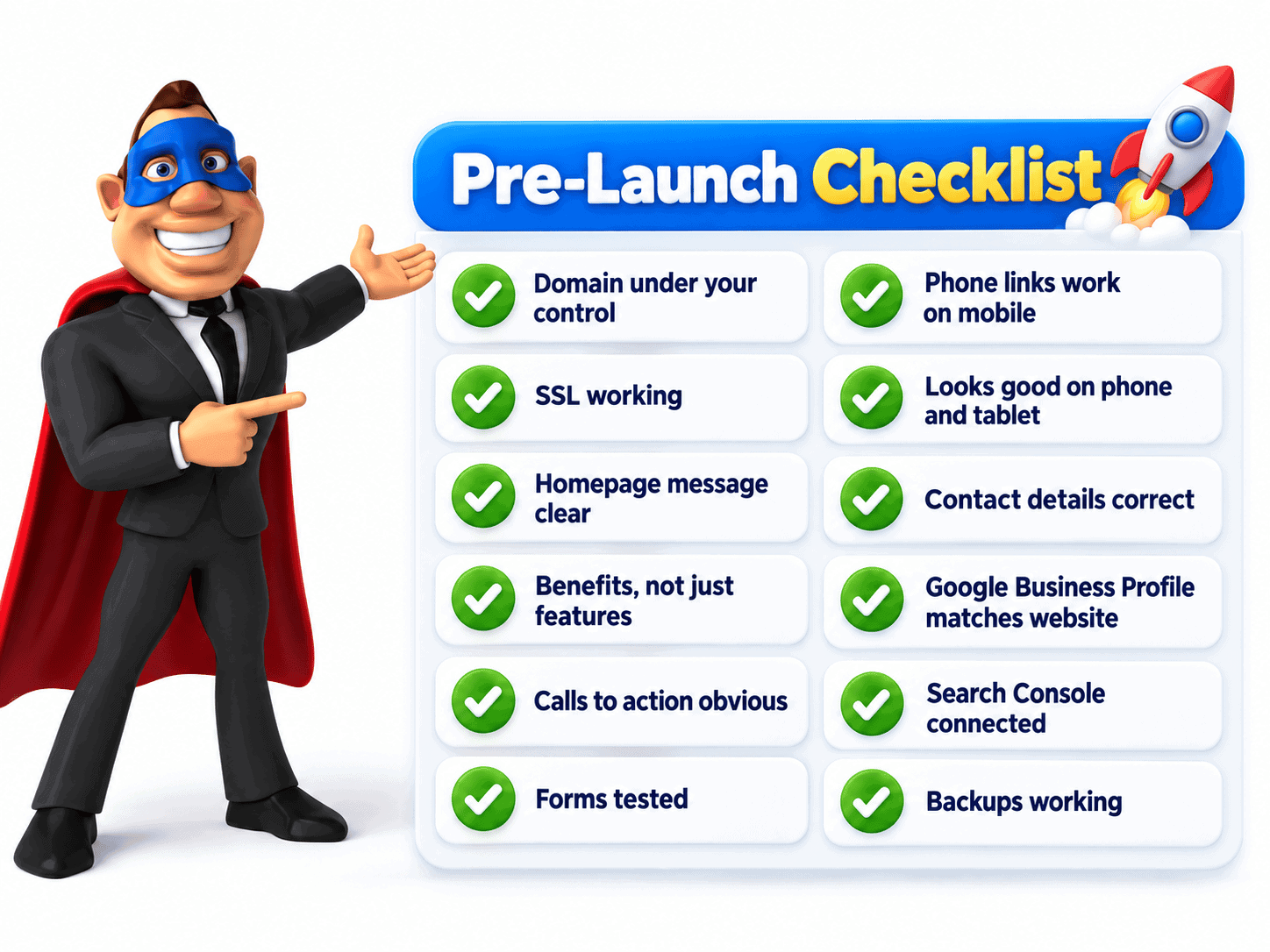
- Domain is registered and under your control
- SSL is working
- WordPress is up to date
- Theme and plugins are current
- Homepage clearly explains what you do
- Benefits are clear, not just features
- Calls to action are obvious
- Forms have been tested
- Phone links work on mobile
- Site looks good on phone and tablet
- Contact details are correct
- Google Business Profile matches the website details
- Search Console is connected
- Analytics or conversion tracking is in place where needed
- Backups are working
Frequently asked questions
Is WordPress still a good choice for a business website?
Yes. WordPress remains a flexible platform for business websites, especially when you want control over your content, design and future growth. The important part is choosing a sensible setup and keeping it maintained.
Do I need lots of pages?
No. Some local businesses can work very well with a focused one-page website. Others need separate service, location or resource pages. The right structure depends on what customers need to know and how they search.
How many plugins should I install?
There is no magic number. Install only the plugins that have a clear job. Fewer well-chosen plugins are usually easier to manage than a large collection of unnecessary ones.
Should I write my website copy before designing the site?
Usually, yes. Your message, offer, benefits and call to action should shape the design. If you design first and try to squeeze the message into the layout afterwards, the website can become confusing.
What makes a business website convert better?
Clear messaging, relevant benefits, strong proof, easy navigation and an obvious next step. The goal is to remove confusion and make it easy for the right customer to act.
Can I build the site myself and get help later?
Yes. WordPress gives you that flexibility. Just make sure the domain, hosting and important accounts stay under your control so another developer can work on the site later if needed.
What makes a useful business website different from a generic WordPress site?
A generic WordPress site can be technically correct and still do very little for the business.
A useful business website connects the technology to a commercial purpose.
It knows:
- who the customer is
- what they are trying to solve
- what information they need before they trust you
- what proof will reduce uncertainty
- what action you want them to take
That is why we do not see website strategy and website design as two separate jobs. The design should support the message, and the message should support the customer’s decision.
WordPress is the tool. The strategy is what makes it work.
WordPress gives you the platform, but it does not automatically give you a good website.
The real job is understanding your customer and building the website around what they need to know, feel and do.
They need to:
find you → understand you → trust you → contact you.
That is the thinking behind our Get Found → Get Chosen → Get More Customers framework.
If you want a deeper look at what a strong business website needs, read What Does a Good Local Business Website Need?.
By Michael Harwood
Bizi Media