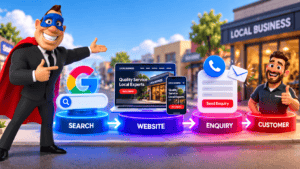
If people are visiting your website but very few are calling, requesting quotes or sending enquiries, the answer is not always “get more traffic”.
Sometimes the bigger problem is what happens after the click.
A local business website should make it easy for the right prospect to understand the offer, trust the business and take the next step. That is the core idea behind a Local Lead Website. When one of those pieces is missing, even good traffic can disappear without becoming a lead.
1. Your first screen is unclear
People should not have to investigate your business to work out what you do.
The first part of the page should quickly communicate the service, the customer or problem you help with, and the next step.
A clever slogan can sound impressive while saying almost nothing. Clear usually beats clever.
2. You are attracting the wrong visitors
Traffic only matters when it comes from people who could realistically become customers.
If your pages target broad or irrelevant search terms, you may get clicks from people who are looking for something different. That produces traffic numbers without producing enquiries.
Start with the profitable services and problems your ideal customers are actually searching for, then build pages and content around those.
3. Your offer is too weak or too vague
A prospect needs a reason to contact you now instead of continuing to compare businesses.
That does not always mean discounting. A strong offer can be about speed, convenience, certainty, a clear process, a useful guarantee, a packaged service or simply making the next step easier.
Explain the result the customer gets and why your way of delivering it is valuable. If this is difficult to articulate, use our five-question guide on how to explain what makes your local business different.
4. The website talks about the business instead of the customer
Experience, history and credentials matter, but customers usually arrive with their own problem at the front of their mind.
Good copy starts with what they need, want, fear, save, avoid or achieve. Your experience then becomes evidence that you can deliver that result.
5. There is not enough proof
People take a risk when they contact a business they do not know.
Reviews, testimonials, before-and-after examples, customer photos, case studies, qualifications, guarantees and real work examples help reduce that risk.
Do not hide all your proof on one testimonial page. Put relevant proof close to the claims it supports.
6. The next step is difficult to find
A visitor who is ready to contact you should never have to hunt through a menu to find out how.
Use clear calls-to-action throughout the page. On mobile, make telephone numbers easy to tap. Keep enquiry forms focused on information you genuinely need at that stage.
7. The site is slow or frustrating on mobile
A local customer may be standing in the street, sitting in a car park or comparing businesses from a phone. A page that takes too long to appear, has tiny text or requires awkward zooming adds friction before the sales conversation even begins.
Test the site on a real phone, not only inside a desktop page builder.
8. There are too many paths
More options can sometimes reduce action.
If the main goal is generating a quote request, every unnecessary button, menu item and competing offer can pull attention away from that goal.
A focused Local Lead Website deliberately guides the visitor through the information needed to make a decision.
9. You have not matched the page to the search
Someone searching for a specific service should land on a page that immediately confirms that service.
Sending every Google Ads click or organic visitor to a generic homepage can weaken the connection between what they searched and what they see.
For important services, a focused service or conversion page can make the journey much clearer. The companion guide What Does a Good Local Business Website Need? covers the core elements worth getting right.
10. You are not measuring the outcome
Without tracking, it is easy to assume a website is working because traffic is increasing.
The numbers that matter are the actions connected to business results: calls, forms, bookings, quote requests and qualified leads.
Once those are measured, you can improve the page based on evidence rather than opinion.
Start with the biggest leak
Do not redesign everything at once.
Look at the customer journey from search to enquiry and identify the biggest point of friction. It might be an unclear headline, a weak offer, missing reviews, slow mobile performance or a confusing call-to-action.
Fix the clearest problem, measure the result, then improve the next one.
That is the thinking behind a Local Lead Website: get the right people to the page, make the choice easier, and make the next action obvious.
Frequently Asked Questions
Why am I getting website traffic but no enquiries?
Usually there is a mismatch somewhere between the visitor, the page and the next step. The traffic may be poorly targeted, the offer may be unclear, the page may lack proof, or the visitor may not know what to do next. Start by checking those basics before assuming you simply need more traffic.
How do I know if the problem is my traffic or my website?
Look at the search terms, campaigns and pages bringing people in, then compare that with the actions they take. If irrelevant visitors are arriving, traffic quality is the problem. If well-matched visitors arrive but rarely call or enquire, the page, offer or conversion path deserves closer attention.
Should I redesign my whole website if enquiries are low?
Not automatically. A full rebuild may be unnecessary if the biggest problem is an unclear headline, weak offer, missing proof, poor mobile experience or confusing call-to-action. Fix the clearest bottleneck first and measure what changes.
What website actions should a local business track?
At minimum, track actions connected to real business outcomes such as phone calls, enquiry forms, quote requests, bookings and important contact-button clicks. Traffic and page views are useful context, but they are not the same as leads.
Can website speed affect enquiries?
Yes. A slow or unstable page adds friction before the prospect has even considered the offer. This is especially important for local customers browsing on mobile connections.