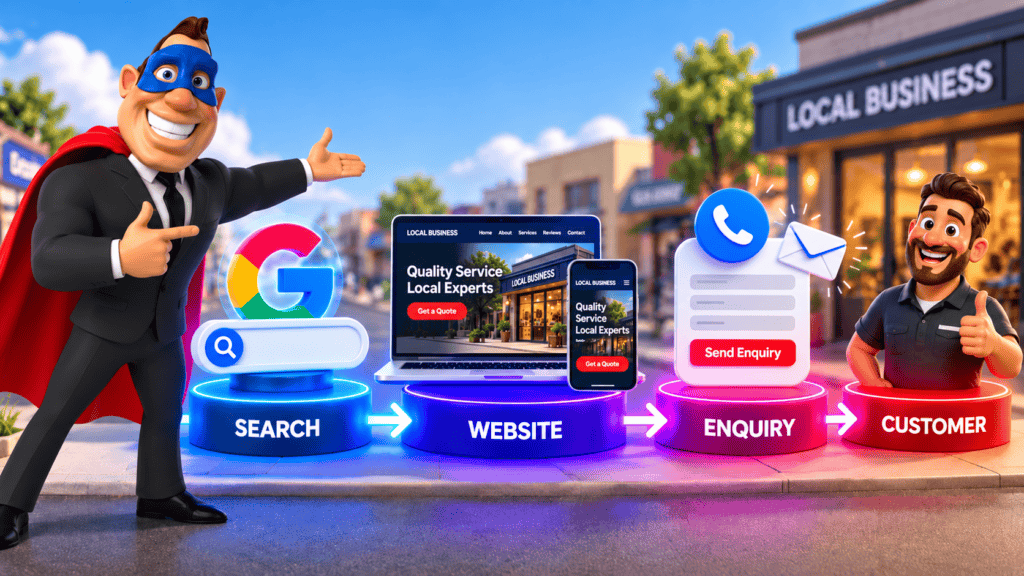
A Local Lead Website is a business website built around one clear job: helping local customers find you, understand why you are the right choice, and take the next step.
That next step might be calling, requesting a quote, making an enquiry, booking an appointment or visiting your business. The important part is that the website is designed around action, not just appearance.
At Bizi Media, we use the term Local Lead Website because it describes the outcome better than “small business website”. A website can look beautiful and still do very little for the business that owns it. A Local Lead Website is designed to help turn local attention into genuine enquiries.
A website should have a job
One of the most common problems with small business websites is that nobody has clearly decided what the website is supposed to do.
There may be a logo, a menu, an About page, a gallery, a few services and some contact details. All of those things can be useful, but they do not automatically create a clear journey for the person visiting the site.
Before you worry about colours, animations or how many pages you need, ask a simpler question: What do I want a good prospect to do after visiting this website?
Once that answer is clear, the structure of the website becomes much easier to plan.
The Local Lead Website framework
A useful way to think about a local business website is in three stages: Get Found, Get Chosen and Get More Customers.
1. Get Found
Your website needs to make it clear what you do, where you do it and which problems or services you want to be found for. That information helps both people and search engines understand your business.
Your Google Business Profile, local search visibility, reviews and useful content can all support this stage. The website then becomes the place where interested local prospects can learn more.
2. Get Chosen
Getting a click is only the beginning. Once someone reaches your website, they need to quickly understand that they are in the right place.
Your headline, offer, proof, reviews, examples, images and explanation of how you help should reduce uncertainty. Good website copy answers the questions a prospect is already asking: “Can you help me?”, “Why should I trust you?”, “What happens next?” and “How do I contact you?”
3. Get More Customers
The website should make the next step obvious. That usually means a strong call-to-action, tap-to-call phone number, short enquiry form or booking option.
Once leads start coming through, you can track what is working, improve the offer and drive more targeted traffic from Google Search, useful content, video, referrals or other channels.
What should a Local Lead Website include?
The exact design depends on the business, but the fundamentals are surprisingly consistent.
A clear first screen. Visitors should be able to understand what you offer without hunting around the site.
A strong reason to choose you. Explain the result you help customers achieve, not only a list of features or services.
Proof. Reviews, testimonials, examples, experience, guarantees, credentials and real customer stories can all reduce risk.
A simple path to action. Do not make somebody search for your phone number, quote form or booking button.
Mobile-first thinking. Local customers are often searching from a phone, so the website needs to work properly on a small screen.
Fast loading. A slow page creates friction before the customer has even read your offer.
Useful search-focused content. Helpful pages and articles can answer real questions and create more opportunities for the business to be discovered.
Does a Local Lead Website have to be one page?
No. A one-page site can work extremely well when the business has a straightforward offer and the main goal is generating calls or enquiries.
More complex businesses may need dedicated service pages, location pages, case studies, resources or other content. An online store, marketplace, membership website or complex application is a different type of project.
The principle stays the same: every page should help the right person move closer to taking action. For the practical building blocks, see What Does a Good Local Business Website Need?.
Why simplicity often converts better
More pages, more menu items and more information do not automatically make a website more persuasive.
For many local businesses, unnecessary choices create distraction. A focused website keeps the prospect moving through the important information in a sensible order: problem, solution, benefits, proof, process and next step.
This does not mean removing useful information. It means removing confusion.
A Local Lead Website is part of a bigger system
A website cannot create demand by itself. It works best when the business also understands who it wants to attract, what those people are searching for, what offer will appeal to them and how traffic will reach the website.
That is why we connect the website to the broader Get Found → Get Chosen → Get More Customers process.
The website becomes the conversion hub in the middle of that system. If you want to see the broader process, read How to Market a Local Business Online: A Simple 3-Step Plan.
The simple test
Open your website on your phone and pretend you know nothing about the business. Within a few seconds, can you answer these questions?
What does this business do? Who is it for? Why should I choose them? What should I do next?
If any of those answers are unclear, there is probably an opportunity to make the website work harder. Our guide to why local business websites fail to generate enquiries can help you diagnose the biggest leaks.
You can see how we apply this approach on the Bizi Media Local Lead Website page.
Frequently Asked Questions
Is a Local Lead Website the same as a normal business website?
Not necessarily. A normal business website may mainly provide information. A Local Lead Website is deliberately structured around helping the right local prospect understand the offer, trust the business and take a clear next step such as calling, requesting a quote or making an enquiry.
Does a Local Lead Website have to be one page?
No. A one-page website can work very well for a straightforward local offer, while businesses with multiple important services, locations or more complex customer journeys may benefit from additional pages. The structure should match what customers genuinely need to make a decision.
Can a one-page local business website rank on Google?
Yes, it can rank for relevant searches when the page is useful, clear, technically sound and supported by the rest of the business’s local presence. A business targeting many distinct services or search topics may eventually need dedicated pages so each topic can be covered properly.
Does a Local Lead Website replace a Google Business Profile?
No. They work together. A Google Business Profile can help a business appear in local search and Maps, while the website gives prospects more information, proof and a clear path to contact the business.
What should the main call-to-action be?
Use the action that best matches how customers actually buy from the business. That might be Call Now, Request a Quote, Book an Appointment, Check Availability or Send an Enquiry. One clear primary action is usually easier to follow than several competing choices.