If you’re running a small business, you’ve probably asked yourself whether you really need a website.
After all, you’ve already got a Facebook page, an Instagram account or perhaps a Google Business Profile. People can find you online, see your photos and contact you. So why spend money building and maintaining a website?
It’s a fair question, especially when you’re trying to keep your business expenses down.
I’ve been building websites for small businesses for years, and I’ve seen firsthand what happens when businesses have no website, a poorly built website or one that actually helps them attract customers.
My answer is simple. If you sell a product or service that people are searching for, your business needs a website.
But there’s something important to understand. Simply having a website isn’t enough. It needs to do a job.
Why Isn’t Facebook or Google Enough?
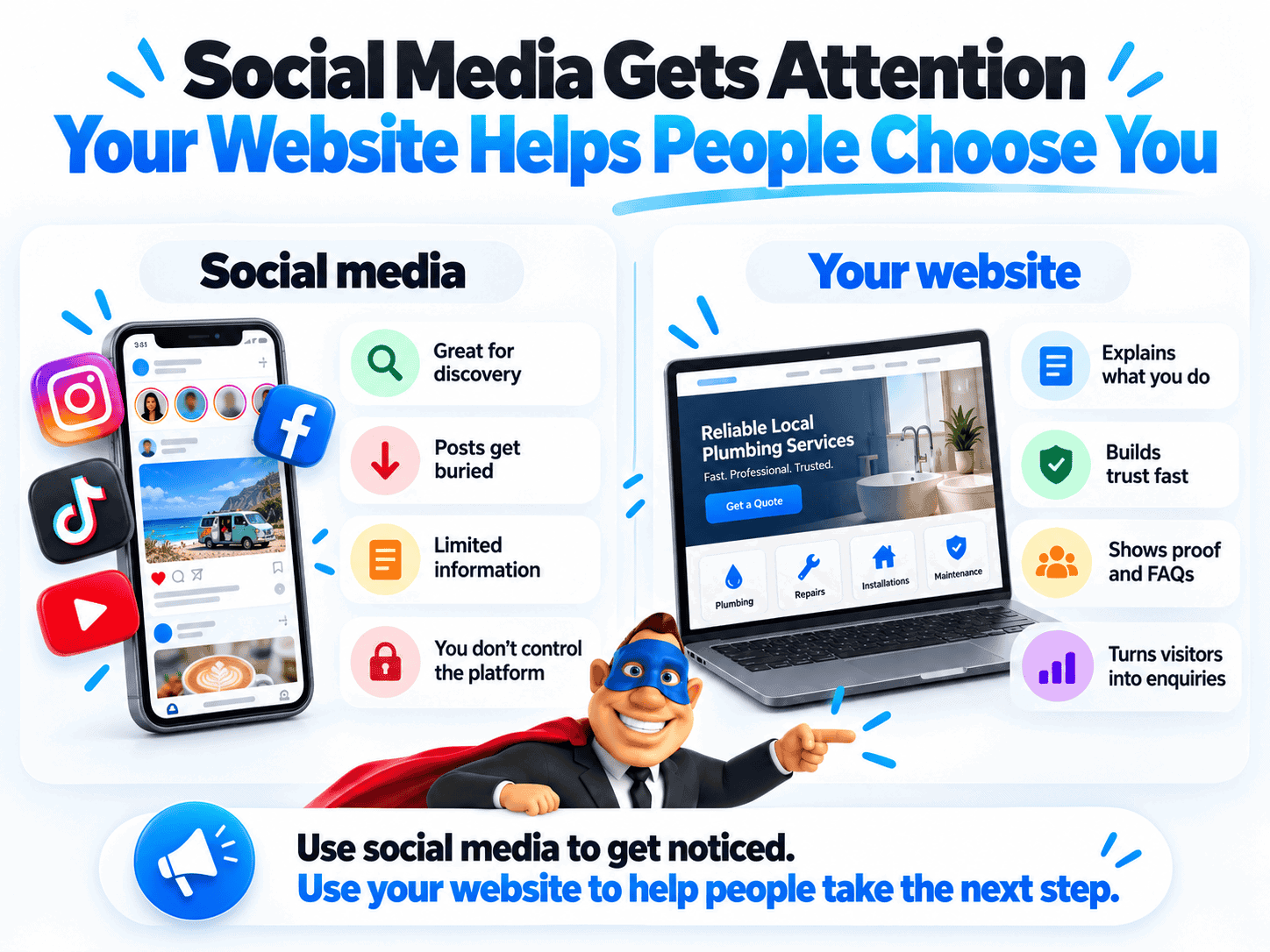
Let me start by saying that Facebook, Instagram and Google Business Profiles are excellent tools for small businesses.
I encourage businesses to use them. They can help people discover you, read reviews, see your work and find your contact details.
But there’s one major problem with relying entirely on these platforms.
You don’t own them.
Facebook and Google decide how their platforms work. They control how your business appears, who sees your content and how people interact with it.
You might be getting plenty of attention today, but there’s no guarantee that the same people will see your business tomorrow.
Algorithms change. Competition increases. Accounts can be restricted. Your visibility can change without you doing anything wrong.
Your website gives you something different. It’s your own online business presence, where you control the content, the presentation and how visitors contact you.
Social Media Is Designed to Keep People Scrolling
Think about what happens when someone visits your Facebook page.
They might be interested in your business, but they’re also surrounded by notifications, videos, advertisements and posts from friends.
Facebook and Instagram are designed to keep people using their platforms.
Someone might visit your page intending to enquire about your service, only to become distracted by something else.
Before you know it, they’ve forgotten why they were there.
A well-designed business website removes many of those distractions.
When somebody visits your website, you have their attention. You can explain what you offer, answer their questions, show them why you’re worth considering and guide them towards contacting you.
That’s a much better environment for turning interest into an enquiry.
Your Website Is Your 24/7 Salesperson
This is how I like to explain the real value of a business website.
Imagine having a salesperson working for your business 24 hours a day, seven days a week.
They’re available when you’re asleep, when you’re busy with customers and when you’re enjoying your weekend.
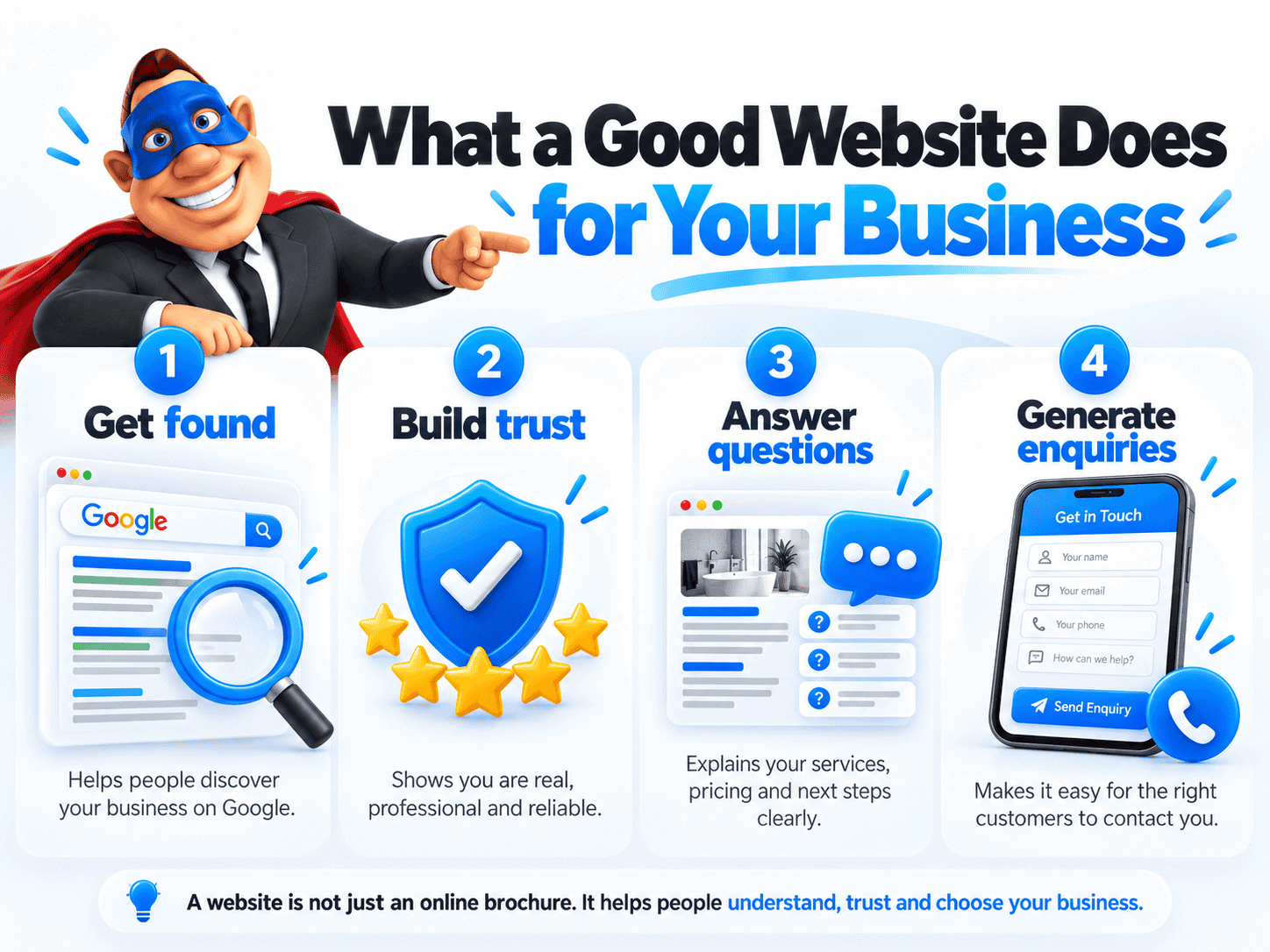
They explain your products and services, answer common questions, show examples of your work and help potential customers decide whether you’re the right business for them.
That’s what a good website should do.
Your website should help people:
- Understand what your business offers.
- Learn about you and your experience.
- Find answers to their questions.
- See examples of your products or services.
- Decide whether you’re a good fit for their needs.
- Feel confident about contacting you.
- Call, email or submit an enquiry when they’re ready.
You don’t need a complicated website to achieve these things.
You need the right information, presented clearly, with an easy way for people to take the next step. I’ve also explained what a good local business website needs.
A Real Example: How a Better Website Helped Boss Dreads Get Enquiries
One of my favourite examples comes from a recent project I completed for Boss Dreads, a professional dreadlock hairstylist based in Surfers Paradise, Queensland.
Boss Dreads already had something many small businesses struggle to achieve.
She was appearing prominently in local Google searches through her Google Business Profile.
People searching for dreadlock services in her area could discover her business.
So visibility wasn’t necessarily the problem.
The problem was what happened next.
The Old Website Wasn’t Building Trust
Boss Dreads had an existing website, but it wasn’t doing her business any favours.
It looked unfinished. Some links were broken, parts of the website weren’t working properly and the information wasn’t presented in a way that helped potential clients make a decision.
Imagine finding a business on Google, clicking through to its website and discovering broken links and incomplete pages.
Would that make you feel confident about spending your money there?
Probably not.
Despite appearing in local Google results, Boss Dreads wasn’t receiving enquiries through the website.
That’s an important distinction.
Getting found online doesn’t automatically mean you’ll get customers.
People still need a reason to trust you and a clear way to contact you.
What I Changed
I built Boss Dreads a completely new website.
Rather than concentrating on making something complicated or flashy, I focused on what potential customers actually needed.
The new website clearly explained her services, presented useful information, helped visitors understand what she offered and gave them an obvious way to make contact.
Everything was designed to make the process easier for the customer.
The website went live on a Monday.
By Tuesday, she was already receiving enquiries.
Now, I wouldn’t suggest that every business will start receiving enquiries the day after launching a website. Results depend on how many people are finding your business, what you’re offering and how competitive your market is.
But this experience demonstrates something I’ve learnt over the years.
Sometimes a business doesn’t need more traffic. It needs to do a better job of turning the attention it’s already getting into enquiries.
And that’s where a well-built website can make a real difference. For more practical examples, see three ways to turn website visitors into enquiries.
Your Website Helps Customers Know, Like and Trust You
Most people don’t immediately buy from a business they’ve never heard of.
They want to know who they’re dealing with.
They might want to understand your experience, see examples of previous work, compare your services or find out how your business operates.
They may also have questions they’re not ready to ask over the phone.
A good website gives them the opportunity to explore those things at their own pace.
This is particularly important for service businesses where customers are inviting someone into their home, trusting someone with their appearance or spending a significant amount of money.
What Makes a Business Website Trustworthy?
From my experience, the most important elements aren’t complicated.
A trustworthy website should have:
- Clear, well-written information about the business.
- Easy-to-understand descriptions of products and services.
- An explanation of who you are and what you do.
- Genuine photos or examples of your work where possible.
- Answers to common customer questions.
- Clear contact details.
- A professional design that works properly.
- A layout that’s easy to use on mobile phones, tablets and computers.
The writing is especially important.
I spend a lot of time thinking about what a potential customer wants to know before deciding to contact a business.
Good website content should answer those questions naturally.
It shouldn’t simply tell people how wonderful the business is.
It should help them decide whether that business is right for them.
Does Every Small Business Really Need a Website?
In my opinion, almost every small business needs one.
If you offer a product or service that people pay for, and those people are searching online, you should have a website.
It doesn’t matter whether you’re a plumber, hairdresser, cleaner, mechanic, consultant, landscaper or local retailer.
People need to know you exist.
They need to understand what you offer.
They need to know whether you can help them.
And they need an easy way to start doing business with you.
When Might You Not Need a Website?
There is one exception I can think of.
If your business is already so busy that you genuinely don’t want any more customers, you might not feel the need to invest in a website.
Perhaps you’re completely booked through referrals and have no plans to grow.
That’s understandable.
Even then, a simple website can still help existing customers find important information without having to call you.
But for businesses that want to attract enquiries, build credibility or continue growing, I believe a website is an essential business tool.
How Much Should a Small Business Website Cost?
This is where things can get confusing.
I’ve seen small business websites advertised for $2,000, $3,000, $4,000 and $5,000 or more.
Larger websites and online stores can cost considerably more.
And there are reasons why professional websites cost money.
Building a website properly takes time.
You need to understand the business, work out what customers are searching for, write useful content, design the pages, make everything work on different devices and ensure visitors can easily make contact.
When you’re doing all of that from scratch, it’s a substantial job.
What I’ve Learnt From Years of Building Websites
For many years, I’ve generally charged around $1,500 to build a small business website.
That covered the time involved in creating the design, writing the content and getting everything working properly.
But something has changed as I’ve gained more experience.
I’ve become much faster at understanding what a business website needs.
I know how to structure the content, what questions customers are likely to ask and how to build pages that encourage enquiries.
I’ve developed a repeatable process that allows me to work more efficiently without sacrificing the important parts.
And that means I can now offer professional websites at a more affordable price.
My $299 Local Lead Website Offer
Through my business, Bizi Media, I occasionally offer a special deal called the Local Lead Website.
At the time of writing, the offer is available to a limited number of businesses, with websites starting from $299.
The idea is simple.
Give small businesses an affordable way to establish a professional online presence that’s designed to generate enquiries. Here’s what a Local Lead Website is and how it works.
Rather than paying thousands of dollars upfront, business owners can get started with a website that focuses on the things that matter.
Clear information. Professional presentation. Mobile-friendly design. And an easy way for customers to contact them.
The special offer is separate from the ongoing hosting and maintenance costs.
You can see the current details of my Local Lead Website offer.
Don’t Forget About Website Hosting and Maintenance
One thing I always explain to business owners is that building the website is only part of the cost.
Your website also needs somewhere to live on the internet.
That’s called web hosting.
And like any other business tool, your website needs ongoing maintenance.
Software needs updating, security needs attention and occasionally something needs fixing or changing.
You may also want a professional business email address using your domain name.
For example, an address such as info@yourbusiness.com.au can give customers another way to contact you.
Should You Manage Your Website Yourself?
You certainly can.
Some business owners prefer to arrange their own hosting and handle their website updates.
Others would rather concentrate on running their business and leave the technical work to somebody else.
Personally, I believe most small business owners have better things to do than worry about website updates, hosting problems and technical settings.
That’s why I offer hosting and maintenance for $50 a month.
It gives businesses the option of having someone look after the technical side while they concentrate on their customers.
Whichever option you choose, make sure you understand your ongoing costs and what support is included.
What About Getting People to Visit Your Website?
There’s another important point that business owners need to understand.
Building a website doesn’t automatically mean thousands of people will start visiting it.
You still need ways for potential customers to find you.
That’s where Google, social media and other marketing activities come in.
And this is why I don’t believe you should abandon your Facebook page or Google Business Profile when you build a website.
They should work together.
Your Google Business Profile can help people discover you when they search locally.
Your social media pages can help you stay connected with customers, share your work and build awareness.
Your website can then provide the information and confidence people need to take the next step.
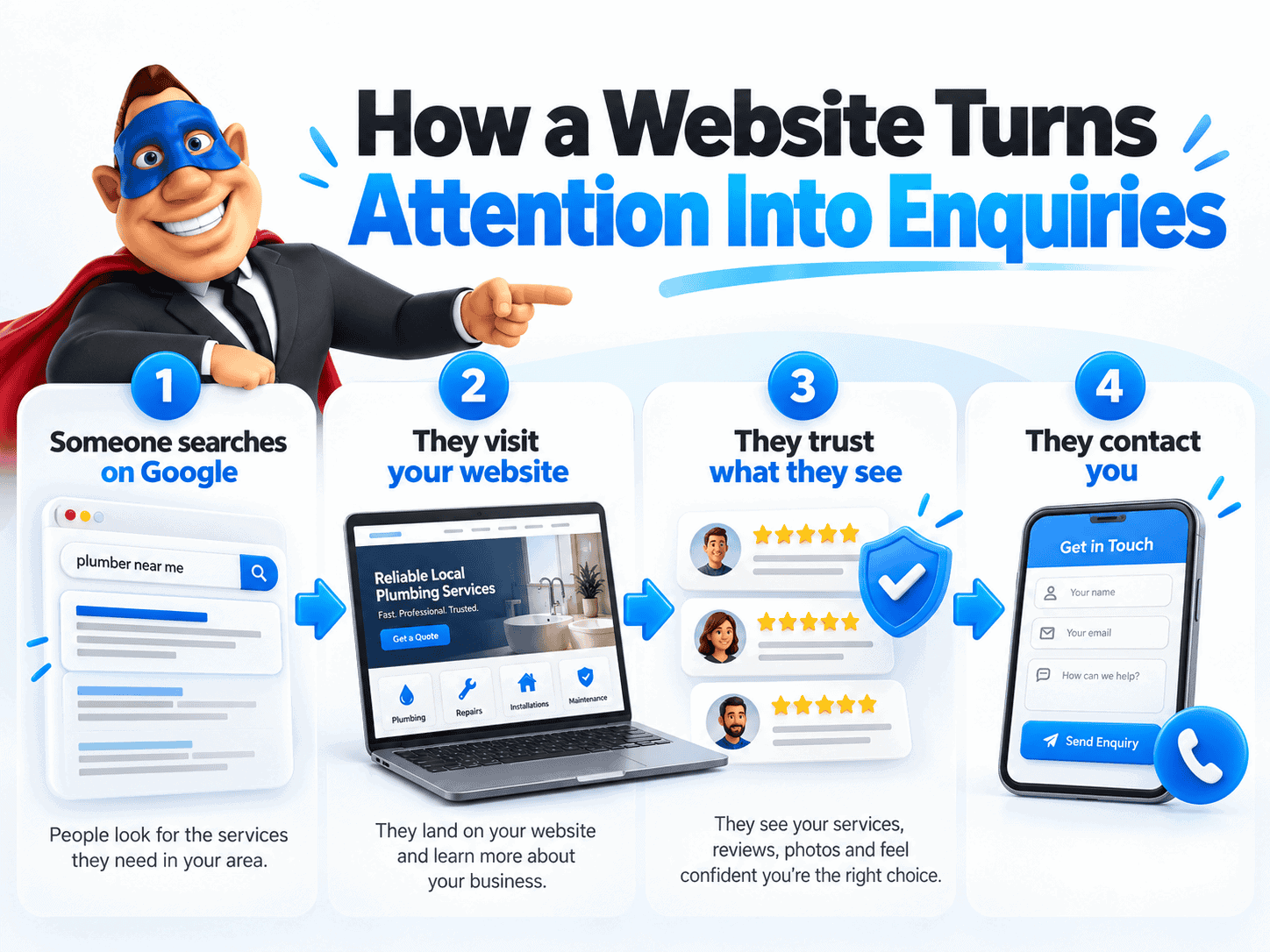
For example, someone might:
- Search Google for a service in their local area.
- Discover your Google Business Profile.
- Read some reviews and click through to your website.
- Learn more about your services and experience.
- Decide you’re a good fit.
- Call you or complete your contact form.
That’s how these different tools can support one another.
Instead of relying entirely on somebody else’s platform, you’re using those platforms to help bring potential customers to your own website.
What Should You Look for When Getting a Website Built?
If you’re thinking about investing in a website, my advice is to concentrate on what the website will actually achieve for your business.
Don’t get too caught up in fancy effects, animations or complicated features.
Start with the basics.
Ask yourself:
- Will people understand what my business offers?
- Does the website explain why they should choose me?
- Does it answer the questions customers commonly ask?
- Will it work properly on a mobile phone?
- Is it easy for visitors to call or contact me?
- Can people find it through relevant Google searches?
- Will I be able to keep the information up to date?
- Do I understand the ongoing costs?
These are much more useful questions than simply asking whether the website looks impressive.
I’ve seen firsthand that a website can look unfinished and actually work against a business.
I’ve also seen how replacing one with a clear, professional website can help turn existing interest into genuine enquiries.
So, Is a Website Really Worth the Investment?
For most small businesses, I believe the answer is yes.
But I wouldn’t encourage anyone to spend thousands of dollars on a website simply because somebody told them they needed one.
The investment needs to make sense.
Think about what a new customer is worth to your business.
If you provide a service worth $500, how many additional customers would you need to recover the cost of a $1,500 website?
Three.
And if those customers return or recommend your business to others, the potential value becomes even greater.
Of course, a website doesn’t guarantee those customers. It needs to attract the right visitors and give them a reason to contact you.
That’s why I focus on building websites that help generate enquiries rather than simply looking good.
A website should be a useful part of your business, not another expense that delivers nothing.
My Final Advice to Small Business Owners
If you’re relying entirely on Facebook, Instagram or your Google Business Profile, I’d encourage you to think seriously about building your own website.
Keep using those platforms. They’re valuable.
But remember that you don’t control how they operate or who gets to see your business.
Your website gives you a place where people can focus on what you offer, learn about your experience, find answers to their questions and decide whether they want to work with you.
It can represent your business 24 hours a day, seven days a week, even when you’re not available to answer the phone.
And it doesn’t need to cost a fortune.
After years of building websites for small businesses, I’ve learnt that the most effective websites aren’t necessarily the biggest or most expensive.
They’re the ones that make it easy for customers to understand what you do, trust your business and take the next step.
That’s what I believe every small business website should achieve.
If you’re considering a website for your business, or you’re wondering whether your existing website is doing its job, visit Bizi Media to learn more about my Local Lead Website service.